BOARD OF DIRECTORS • Lloyd Axworthy • Sue Dick • Gordon Edwards • Hilal Elver • John Feffer • Mary Kaldor • Adam Koniuszewski • P.V. Rajagopal • Doug Saunders • Metta Spencer • Ronald St. John • Peter Wadhams • Alyn Ware • Paul Werbos
HONORARY PATRONS • Douglas Roche • Frank Sommers
GUEST EDITOR • Jill Carr-Harris
ASSOCIATE EDITORS, THIS ISSUE • Sue Dick • Michaela Ehring • Subir Guin • Stephen Harold Riggins • Alan Heirich • Olivia Ward • Adam Wynne
LAYOUT • Cameron Darcy
BUSINESS OFFICE • P. O. Box 248, Toronto P, Toronto M5S 2S7. Telephone: 437/887-6978. Email: office@peacemagazine.org
EDITORIAL OFFICE • E-mail: mspencer@web.net • Web: www.peacemagazine.org
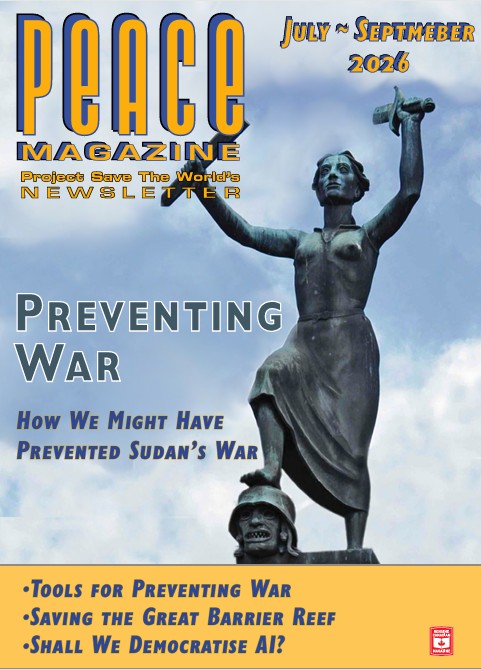
FRONT COVER • Christine Schweitzer, Irene Publishing
BACK COVER • April M. Short, Pressenza IPA
OUR WEBSITES • peacemagazine.org • tosavetheworld.ca
SUBSTACK • ProjectSaveTheWorld.substack.com
SUBSCRIPTIONS
Peace Magazine is now the official quarterly newsletter of Project Save the World. We send free digital copies to NGOs worldwide that are working to prevent these global catastrophes: war and weapons; global warming; famine and water shortage; pandemics; radioactive contamination; cyber risks; and threats in the economy, governance, human rights, and civil society. If your group wishes to receive this newsletter regularly, just send us its email address.
You can still subscribe for digital editions only: $19.99 per year, globally, to read on any computer or smartphone, available only through PressReader. On your computer or cell phone, log in to PressReader. Then, in “Search Publications,” type Peace Magazine to see subscription and credit card options.
Indexed in Canadian Index (ProQuest/Micromedia) and the Alternative Press Index (U.S.), and on our website: peacemagazine.org.
Print copies of back issues are available at $4.50 each plus postage.
Peace Magazine (ISSN 0826-9521) is published four times a year by Project Save the World. Mail can be sent to P.O. Box 248, Station P, Toronto, ON M5S 2S8. Advertising, single-copy sales, and editorial enquiries should also be sent to this address.
Project Save the World’s only officially endorsed positions are stated in the Platform for Survival shown on our website, tosavetheworld.ca. Because we are an open forum, views expressed by contributors do not represent the opinion of Project Save the World or this newsletter, Peace Magazine. Although we are concerned about the dangers of artificial intelligence, we use it liberally for research, editing, and design purposes.
Editorial or pictorial content may be reproduced in any medium, provided that reprints are prominently credited and copies of any reprinted materials are forwarded to us. We assume no responsibility for unsolicited materials. However, we encourage readers to submit articles, notices, photos, and art—but no poetry or fiction, please.
We maintain electronic and paper records at our offices. A data protection statement is available on the Peace Magazine website at www.peacemagazine.org or on request.
Publications Mail Agreement No. PM40065350
Return undeliverable Canadian addresses to:
PO Box 248, Station P
Toronto, ON M5S 2S7
Email: mspencer@web.net
From the Editor
Sudan has been devastated by civil war, creating one of the world’s gravest humanitarian crises in recent history. Nearly 19.5 million people face acute food insecurity, and almost one million children suffer from extreme malnutrition. Yet this catastrophe receives far too little international attention. As countries such as Canada work with other middle powers to shape a new global order, does Sudan illustrate the risk of neglecting peace and human security?
Canada pledged CAD 120 million in humanitarian assistance for Sudan in 2026 in response to the international donor conference in Berlin last April. While this is welcomed, it pales beside Canada’s projected CAD 63 billion defence budget this year. Strengthening national defence is important, but it should not come at the expense of Canada’s global responsibilities. Humanitarian assistance and peacebuilding are essential investments in preventing conflict and reducing human suffering.
Canada is well positioned to address the roots of the Sudan conflict. Beyond humanitarian aid, it could champion diplomacy and civilian protection through the United Nations and the Responsibility to Protect (R2P) framework. It could also modestly increase investment in peacebuilding, UN peacekeeping, and human security—areas that would reinforce, not weaken, Canada’s overall security.
Canada should further support accountability through the International Criminal Court (ICC). As a State Party, it can advocate investigations into atrocities committed during the conflict, reinforcing international norms against genocide and war crimes.
The recent appointment of Louise Arbour as Governor General highlights Canada’s capacity to champion justice and human rights. In this edition, “How We May Have Prevented Sudan’s Wars,” “Tools for Preventing War,” “Article 109,” and “The Criminology of War” explore how Canada can respond to Sudan through multilateral action, peacekeeping, and international justice.
As Arbour observed, “No security without development; no development without security; and no security and development without human rights.”
Jill Carr-Harris
Guest Editor